
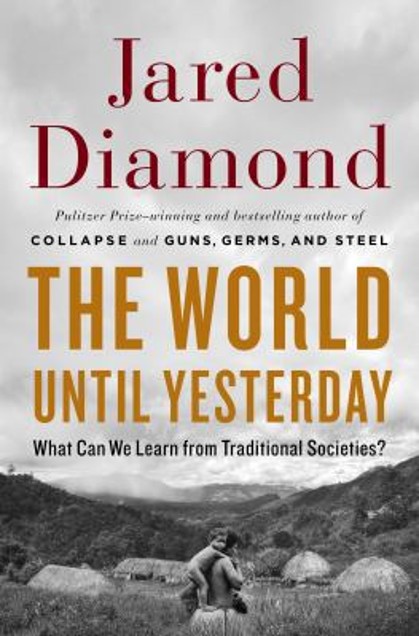
The World Until Yesterday: What We Can Learn from Traditional Societies
Traditional Societies and Human Intelligence
Part 1 – 5 Minutes In
Almost immediately, I felt like I understood where this book was headed. In many ways, it feels like a continuation of Guns, Germs, and Steel. One of the central arguments Diamond made in that book was that societies that developed differently from modern industrial civilizations were not less intelligent. Instead, differences in development were often tied to geography, resources, opportunity, and historical circumstance.
Diamond gives examples of societies quickly adapting to unfamiliar technologies, animals, and agricultural systems when exposed to them. Whether it was horses introduced to Native American groups or crops introduced into new regions, many societies rapidly learned how to use and benefit from these innovations. His point was that intelligence was never the limiting factor.
Within the first few minutes of The World Until Yesterday, Diamond describes Papua New Guineans working as pilots and airport staff-roles requiring technical skill and training-despite their communities having lived much more traditional lifestyles only one or two generations earlier. That image challenges a common assumption many Westerners, especially white Westerners, historically held when viewing traditional societies.
People often saw hunter-gatherer communities or societies with minimal clothing and assumed they were intellectually inferior. But the speed with which these groups adapted to modern systems and technology demonstrates otherwise. It suggests that differences in development are more about access to resources, infrastructure, and opportunity than about innate intelligence.
Cross-Cultural Psychology and the Limits of WEIRD Research
Part 1 – 22 Minutes
Diamond points out that much of modern psychology has historically been based on studies of middle-class white Western undergraduates. That observation is incredibly important.
When we consider how different human experiences can be across cultures, environments, and economic systems, it seems inevitable that psychology and sociology will continue evolving as fields. We will likely discover many findings that challenge assumptions previously treated as universal truths.
At times, this will probably create confusion and frustration within these disciplines as researchers continue trying to define what aspects of human behavior are universal versus culturally shaped. Still, there will also be important breakthroughs as we identify both the commonalities and differences that exist across societies.
Cultural Relativism and Lessons From Traditional Societies
Part 2 – 5 Minutes, 45 Seconds
One way to view this book is as a survey of humanity’s cultural and societal experiments. Different societies developed different practices for parenting, conflict resolution, economics, religion, and community life. By studying them comparatively, we can ask which practices may still have value today.
In the United States and much of Western society, there is often an unspoken assumption that our cultural practices are inherently the best. But many of us arrive at that belief simply because we were born into these systems-not necessarily because we have thoughtfully compared them to alternatives.
America’s economic dominance and global cultural influence can reinforce this mindset. However, the rise of the internet and global communication has increasingly exposed people to other ways of living. More and more, we are realizing that Western societies are not automatically the best at everything.
This book contributes to that broader awareness. It encourages readers to examine other cultures not from a position of superiority, but from curiosity and humility.
Barter Economies, Money, and Conflict Resolution
Part 4 – 32 Minutes
Diamond discusses different economic and compensation systems, particularly within traditional Papua New Guinean societies, where exchange was often based on barter systems and social relationships rather than abstract currency.
From the perspective of someone living in a modern capitalist society, it can seem strange that people would exchange valuable goods and labor for pieces of paper or digital numbers in a bank account. Yet traditional societies also developed symbolic systems of exchange, such as cowrie shells and other culturally valued items, even if those systems differed from modern Western currency systems.
Another major theme in this section is reconciliation after conflict, including disputes involving death. In some traditional societies, conflict could escalate into cycles of revenge killings. To prevent this, communities sometimes developed systems involving emotional reconciliation alongside material compensation.
Importantly, Diamond notes that these compensatory payments were never viewed as equal to the value of a lost life. Instead, they functioned as part of a broader process aimed at restoring relationships and reducing further violence.
That idea stood out to me because Western legal systems often emphasize civil or criminal penalties while giving far less attention to emotional reconciliation. When reconciliation does occur, it is usually driven by the individuals involved rather than being embedded into the legal or cultural process itself.
I think Diamond highlights something valuable here. Emotional reconciliation may not replace legal accountability, but incorporating it more intentionally into conflict resolution could benefit many people and communities.
Another interesting aspect is that responsibility in these traditional systems often extended beyond the individual offender. Entire families or clans could become involved in reconciliation efforts or protection against retaliation, reflecting a much more collective social structure than what exists in most Western societies today.
Restorative Justice vs the American Legal System
Part 5 – 14 Minutes, 37 Seconds
Diamond again critiques aspects of the American legal system, particularly its limited focus on emotional reconciliation. He contrasts this with traditional Papua New Guinean practices that attempt to restore social harmony after conflict.
It makes me wonder whether there is room in the United States for institutions-formal or informal-that focus more directly on emotional healing after serious wrongdoing or wrongful death. Some restorative justice programs already move in this direction, but it still feels relatively uncommon within mainstream legal culture.
Diamond also discusses how, in the American legal system, losing plaintiffs are generally not required to pay the winning party’s legal fees. While this can increase access to lawsuits in some cases, it also creates situations where wealthy individuals or corporations can overwhelm less wealthy opponents through prolonged legal battles and expensive attorneys.
I remember hearing discussions comparing this system to the United Kingdom, where losing parties are more often responsible for legal costs, potentially discouraging excessive litigation.
Human Nature, War, and Revenge Killings
Part 9 – 4 Minutes, 22 Seconds
One major takeaway from the section on war is that conflict appears throughout nearly all human societies in some form. As far as we know, there are no clear genetic predispositions making one population inherently more violent than another. Differences in violence and warfare seem to be shaped far more by culture, environment, and social structure.
Diamond also discusses revenge systems in which family members or groups retaliate after the death of someone within their community. While Western societies generally discourage this behavior and instead rely on the state and judicial systems, revenge-based systems can provide a sense of emotional resolution for grieving individuals.
At the same time, those systems can also spiral into cycles of retaliatory violence and long-term conflict.
One major strength of modern state legal systems is that they reduce revenge killings by placing responsibility for justice in the hands of courts and institutions rather than individuals or families. However, one downside is that the emotional needs of victims and families can sometimes feel neglected.
That tension appears repeatedly throughout the book: modern systems may reduce violence and increase stability, but they do not always satisfy emotional or communal needs.
Child-Rearing Across Cultures and Parenting Differences
Child-Rearing and “WEIRD” Populations
One particularly important idea in the book is that much Western parenting advice is based on research involving “WEIRD” populations-Western, Educated, Industrialized, Rich, and Democratic societies.
Historically, researchers often treated findings from studies involving college students or white middle-class Western families as universally applicable. But when we compare parenting practices across cultures, it becomes clear that different approaches can produce healthy outcomes in different contexts.
Some traditional societies immediately comfort crying infants, co-sleep, or involve extended family heavily in child-rearing, while Western parenting trends have varied dramatically over time.
This raises an important question: how much of what we call “expert advice” is truly universal, and how much is culturally specific?
The book encourages readers to think comparatively rather than assuming one parenting style is objectively superior in all contexts.
How Different Cultures Treat the Elderly
Part 10 – Treatment of the Elderly
The section discussing how different societies treat the elderly made me think an anthology television series exploring these practices could be fascinating if done respectfully and objectively.
Some societies deeply revere elders for their wisdom and experience, while others historically practiced abandonment or euthanasia under harsh survival conditions. The contrast between these approaches is dramatic and reveals how strongly cultural values shape our treatment of aging and dependency.
Masculinity, Fear, and Teenage Angst Across Societies
Part 13 – Teenage Angst and Masculinity
Diamond notes that what many Western societies view as normal teenage angst and insecurity are not necessarily universal experiences. In some traditional societies, clearly defined social roles and stronger communal integration may reduce those feelings.
Similarly, traits often associated with masculinity in Western cultures-such as hiding fear or emphasizing performative bravery-also appear to vary significantly across societies. Some cultures living in dangerous environments may actually encourage openness about fear and caution rather than glorifying risk-taking.
Religion, Language Preservation, and Cultural Identity
Part 21 – General Takeaways
One of the biggest lessons from this book is that there are many viable ways for human societies to organize themselves. Coming from an American perspective, it is easy to unconsciously assume our systems are the default or the best simply because of our economic and global influence.
But The World Until Yesterday encourages a more comparative mindset. Different societies developed different solutions to universal human problems, each with their own advantages and disadvantages.
Another useful way to think about the book is as a collection of cultural and social experiments. Humanity has already tested countless approaches to parenting, justice, economics, language, religion, and community structure. By studying those experiments, we may identify practices worth preserving, adapting, or learning from.
Diamond also discusses religion and language evolution. Regarding religion, he explores theories suggesting that religions may have emerged partly from humanity’s desire to explain the unknown or from our tendency to recognize patterns and agency in the world around us.
On language, Diamond argues against the idea that humanity would necessarily benefit from converging into a single global language. Languages contain cultural history, knowledge systems, and unique ways of thinking. Because of this, preserving endangered languages matters.
Today there are roughly 7,000 languages spoken worldwide, many with relatively small speaker populations. Globalization may continue reducing linguistic diversity over time, making language preservation increasingly important.
The book also critiques aspects of the Western diet, arguing that modern food systems overload people with sugar, salt, and processed foods in ways our bodies were not evolutionarily designed to handle. Public health interventions and changes in food manufacturing may be necessary to address these issues.
Another point I found interesting was the observation that groups with intentional shared cultural practices often develop stronger group identity and social cohesion, which can contribute to socioeconomic success. That idea made me think about how cultural identity functions within different communities, including Black American communities and broader discussions around cultural preservation and collective advancement.
Final Thoughts on The World Until Yesterday
Overall, The World Until Yesterday challenged many assumptions about what is “normal” or “best” in human society. Rather than romanticizing traditional societies or dismissing modern ones, Diamond encourages readers to think comparatively and critically.
The book ultimately suggests that modern societies still have much to learn from traditional cultures-not because one is universally superior, but because human societies have developed many different solutions to the same fundamental human problems.
Original draft written in October 2020.

