
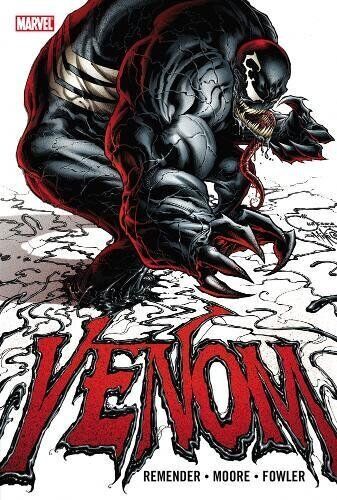
Continuing My Review of Venom: Rex (Issues #1–6)
So I just read a little bit more of Venom by Donny Cates, Volume One: Rex (issues #1–6), and I had a few quick thoughts.
Villain Monologues and Comic Book Storytelling
Is Exposition Through Monologues Lazy Writing?
There’s a part in the book where the villain, I think his name is Rex, gives this long monologue explaining his entire background to Eddie Brock.
In a natural sense, it really does not make much sense for someone to stop and explain all of this information to the protagonist. But obviously the purpose is to give the audience background information on the character and the larger mythology.
I know a lot of people consider this kind of thing lazy writing.
And honestly, it is an easy storytelling shortcut. It is a very direct way to communicate exposition quickly. Comic books, movies, anime, and fantasy stories do this all the time.
I often wonder what more natural alternatives would look like. I would like to see more examples of writers communicating character backstory in subtler or more realistic ways because the “villain explains everything” approach has become very recognizable.
At the same time, I understand why writers use it. Sometimes stories just need efficient ways to explain complicated mythology.
Still, I do think it stands out as one of the weaker aspects of the writing here.
Representation and the “Default White Male” in Fantasy
Thoughts on Knull’s Character Design
Another thing I did not necessarily care for was the design of the ancient cosmic villain.
This being is supposed to have existed before time itself, before civilization, and even before the universe as we know it. Yet visually he still resembles a blond-haired white man.
To me, that reflects a broader tendency in Western media where the white male is often treated as the default version of a person, even in stories involving gods, aliens, cosmic beings, or entities older than humanity itself.
I do not necessarily think the writers or artists did this intentionally or maliciously. It is probably more of a byproduct of the culture they exist within and the types of characters creators unconsciously default to designing.
Still, I think it is worth critiquing from a broader societal perspective because these kinds of creative defaults shape how audiences imagine power, centrality, and universality.
The Symbiote Prison Twist Explained
The Real Truth About the “Planet of the Symbiotes”
There was an interesting twist in the story that I actually liked.
This book definitely assumes at least some prior knowledge of Venom lore because it references the “world of the symbiotes” pretty casually at first, almost as if readers are already supposed to know what that means.
They eventually explain it fairly quickly, but initially it feels like background knowledge is expected.
What turns out to be interesting is that this so-called world of the symbiotes is not really their home world at all. Instead, it is basically a prison holding Knull, the god and creator of the symbiotes.
The reason the symbiotes imprisoned him is because at some point their connection to him was severed. After bonding with other life forms across the universe, the symbiotes started adopting characteristics, emotions, and values from their hosts.
In a sense, they evolved.
By connecting with living beings, they changed psychologically and morally, which caused them to eventually rebel against their creator and imprison him.
That is actually a pretty interesting concept.
Thor, Symbiotes, and Marvel Cosmic History
The Turning Point in Knull’s Downfall
Apparently the major turning point came during a battle involving Thor centuries ago on Earth.
According to the story, Knull arrived on Earth planning destruction, and Thor fought him and severed his connection to the symbiotes. That moment supposedly triggered the chain of events leading to the symbiotes eventually turning against him.
There was one part that stood out to me, though.
A character references these events as happening “long ago,” but the timeline feels a little inconsistent when you think about the mythology involved. Since Thor and Norse mythology are connected to relatively recent human history compared to the age of the universe, it does not really feel ancient on a true cosmic timescale.
I do not know if they mentioned Beowulf specifically, but references like that make the timeline feel slightly strange.
Still, comic book continuity is often messy, so I am not too bothered by it.
The Strength of Venom: Rex Is the Mythology
Why the Symbiote Lore Is More Interesting Than the Plot
Overall, I still think this comic is more important for the mythology it introduces than for the actual story itself.
Some parts of the plot still feel a little forced to me. The pacing and dialogue are not always smooth, and some developments happen mainly because the story needs them to happen.
But the larger ideas are interesting:
- the origin of the symbiotes
- cosmic horror mythology
- the god Knull
- symbiotes evolving morally over time
- Marvel’s deeper cosmic history
Those concepts are strong enough to keep me interested even when the actual narrative structure feels uneven.
At the very least, the comic delivers some genuinely interesting visuals and expands Venom’s mythology in a way that makes the character feel much larger and more important within the Marvel universe.
Original draft written in February 2021.

