
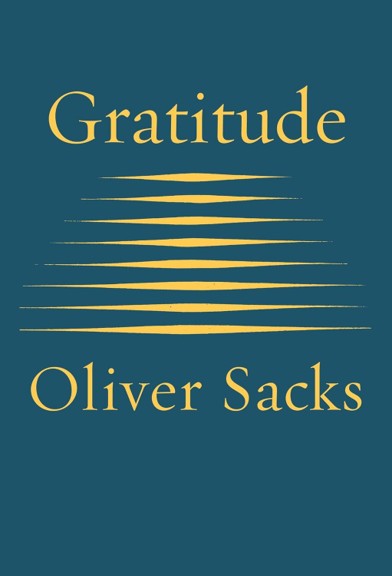
I’m recording a few thoughts on the book Gratitude by Oliver Sacks.
Gratitude is the last book Oliver Sacks published, I believe. It’s a very short book—the audiobook version is only about 36 minutes long.
This book was written after Sacks found out he had terminal cancer. If I remember correctly, he had previously been diagnosed with melanoma, and later discovered that it had traveled to his liver and metastasized there. At that point, it was difficult to do much medically. His doctors were able to treat him enough to give him a few more months, good-quality months, before the end.
The book is essentially a reflection on his life. It’s Oliver Sacks expressing his appreciation, his gratitude, for what he’s experienced.
I learned from the book that Oliver Sacks was Jewish, and that Judaism and faith were part of his life early on, as well as a big part of his parents’ lives.
When he came out as gay, religious attitudes at the time labeled it as an “abomination.” That’s what began his estrangement from his mother and, eventually, from much of the Jewish community. From that point on, he had to find his own path. At one point, he talked about moving to America. Before that, he and his family were living in England, I think during World War II, when Jews were being persecuted. Eventually, the family left their home. I’m not sure if they all came over together or if it was just him, but he ended up in America, possibly in California. There, he became involved in a muscle-building community and found a group of friends.
He also talked about how he got into psychology. Ultimately, he built his career there, but in his later years he admitted that he didn’t necessarily keep up with psychology and neuroscience as much. He was definitely more interested in physics and chemistry and even had a special fondness for the periodic table. Each year on his birthday, he would associate his age with the corresponding element’s atomic number.
He had a fascinating relationship with science. I thought it was funny that he told a story about once giving a friend a vial of mercury as a birthday gift. The friend replied that he “takes a little each morning just to stay in good health,” or something along those lines.
I think it’s refreshing to hear someone reflect on their life at its end, especially someone who, by most people’s standards, had a successful life, and openly acknowledge and appreciate their experiences.
He also mentioned that he still had patients who were older than he was, who passed away before he did. It made me think about how they might have felt about their own mortality. Probably not much different, he implied, though in his case, death was coming from cancer rather than natural causes.
Overall, I found it refreshing to see someone come to terms with their own death with such honesty.
Original post written in July 2020
 Gazing off into Space