
Spoilers!
Loose Ends Tied: “The Stone Sky” Delivers Satisfying Conclusions
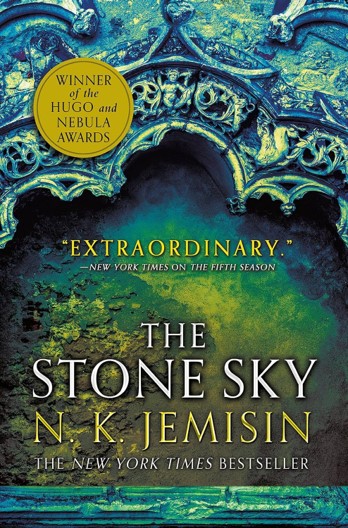
I’ve just finished reading the final installment in the Broken Earth trilogy, The Stone Sky by N. K. Jemisin. So, what can I say about this book? Well, it thankfully ties up most of the loose ends in the story. We finally learn about the fate of civilization thousands of years ago, as well as the current one. Naturally, we get closure on Nassun and Essun’s arcs, and we discover what happens to Schaffa. Rusafa’s story reaches its conclusion. And Earth itself provides closure. Additionally, we gain further insight into Alabaster in Alabaster’s chapter.
So, I listened to one person’s review of the book, and it seems they didn’t enjoy it as much. One of the main issues they had was the desire for more story, an additional narrative within the book. Essentially, they felt that this book was merely a continuation of the last two books. Throughout this installment, a significant amount of time is spent traveling with our characters. We accompany Essun and Nassun as they journey to the new community, and we’re also with Lerna and Schaffa as they make their way to Tonkee and the Corepoint. Thus, there’s a considerable emphasis on travel. The reviewer, who happens to be a podcaster, expressed dissatisfaction with this aspect, wishing for a fresher perspective or a new angle on the world. However, personally, I didn’t mind it. I found the strength of this series lies in its characters.
Journeys of Exploration: A Focus on Character Interactions
Indeed, it’s primarily a character-driven story. From that perspective, I can understand why some might not find it as engaging. However, being the third book in the series, I’m personally invested in seeing how the characters’ journeys conclude. There’s a sense of anticipation for the final resolution. Certain plot points become somewhat predictable; for instance, it’s expected that someone will bring Essun’s son back and that there will be a showdown between Essun and her daughter, Nassun. These expectations are met, which isn’t necessarily a bad thing. I did anticipate some form of conflict or confrontation involving Schaffa, but it didn’t play out as I imagined. Nevertheless, it wasn’t disappointing.
Well, some worlds are built on a fault line of pain, held up by nightmares. Don’t lament when those worlds fall. Rage that they were built doomed in the first place.
― N.K. Jemisin, The Stone Sky
Unveiling the Past: Ancient Society, Obelisks, and the Habilis Revealed
Eventually, the Stone Room, or the cornerstone, crumbled, and it was quite unsettling to witness all the guardians being killed. That’s certainly a grim development, indicating the flawed nature of those in power. I find myself struggling to articulate much about the book. One point the podcaster brought up was feeling underwhelmed by the backstory set thousands of years ago. Personally, while some of the technical details were a bit dense for me to fully grasp, I did manage to get the gist of it. The explanation regarding the Habilis and the onyx obelisks, among other things, provided insights into the ancient society and the world’s previous state. It was satisfying to receive this comprehensive explanation, especially after encountering numerous hints throughout all three books. Overall, I found it to be a satisfactory resolution.
I suppose one point he raised is that perhaps the backstory could have been integrated more evenly throughout the entire book. Instead of having it all revealed in one concentrated section, spreading it out could have enhanced the storytelling. It might have added intrigue and depth to the narrative if we gradually learned about the events of the past from various perspectives throughout the book. However, I can also see how the decision to present it as a single revelation could be viewed as an interesting choice, adding a sense of anticipation and climax to that particular aspect of the story.
High-Stakes Showdown: Mother vs. Daughter
Ah, so essentially, Nassun, Essun’s daughter, played a pivotal role in the showdown between Essun and Nassun. Nassun’s plan involved seizing control of the moon to either crash it into Earth and annihilate everyone or turn everyone into stone. Initially, she seemed inclined towards the former option but later changed her mind, aiming to save Schaffa instead. His intention was to restore balance to the world by bringing back those turned to stone. However, the decision-making process during the fight between mother and daughter made for an interesting twist. While everything ultimately resolved itself, this choice introduced some risk and potentially weakened the overall tension of the situation.
So, in the end, Essun faced a complex moral dilemma. She had to choose between saving everyone on Earth and allowing her daughter to live. It’s a difficult decision, and it reflects the complexity of Essun’s character. She’s not a straightforward hero; she has a history of violence and mistakes, making her a flawed character. Despite her efforts to save her daughter, she ultimately prioritized Nassun’s life over the fate of everyone else on Earth. Logically, it might have made more sense to take action against her daughter, even if indirectly. This choice would likely have resulted in Nassun’s demise, given her young age and the danger she posed. It’s a morally and emotionally charged situation that adds depth to Essun’s character.
When the world is hard, love must be harder still.
― N.K. Jemisin, The Stone Sky
It’s intriguing how despite her young age, Nassun displayed a stubbornness and tendency to make emotional and questionable decisions. But it’s important to remember that she’s just a 10 or 11-year-old child; her understanding of the situation is limited. The dynamic between Essun and Nassun is complex; there’s a strong emotional bond between them, which complicates their choices. Essun was willing to sacrifice the rest of the world to ensure Nassun’s survival, which is a profound and morally challenging decision. Nassun, on the other hand, was prepared to turn everyone into stone eaters to save Schaffa. These choices highlight the intense emotional connections and conflicts within their relationship.
Indeed, Essun is a complex and flawed character, far from the idealized hero archetype. Her decisions and actions throughout the story reflect this complexity, especially when faced with the dilemma of saving her daughter at the expense of others. It’s thought-provoking to consider how such situations might unfold in real life and what choices a mother would make in such circumstances.
As for Essun’s backstory, the revelation that she had already experienced the loss of two other children, along with an unborn child, adds layers to her character. This history of loss undoubtedly influences her decisions and motivations, particularly her desperation to protect Nassun at any cost.
Regarding Schaffa, he remains a compelling character despite his unsettling nature. His unwavering commitment to his mission, even when influenced by the Corepoint, adds an eerie element to his character. While he never fully regains control of his own actions, his role as a hero of sorts persists until the end of the book. Nonetheless, his connection to the Corepoint and his stone-eating abilities do contribute to an unsettling aura surrounding him.
Alabaster’s Transformation
It’s fascinating to witness Alabaster’s transformation, essentially ascending to become a stone eater and achieving a form of immortality. It leaves one wondering if others will undergo similar fates as the story progresses. The intricacies of the book linger in the mind, inviting further reflection upon later returns to it. Overall, I find the trilogy to be quite satisfying. As you’ve noted, its strength lies in its richly developed characters and the character-driven nature of the story. That wraps it up for now.
Original draft written in August 2019
 Gazing off into Space
After reading the trilogy I was surprised at how the loss of Lerner is tossed aside, almost literally, followed by Essun choosing to be killed by her daughter without a thought to the unborn child she is carrying. Some decisions just didn’t ring true for me.
LikeLike